
Some artists speak about their work through milestones. Others speak through continuity. This conversation belongs to the latter. Rather than pointing to a defining moment or a single breakthrough, Musachi frames making as something that has always been there, quiet, consistent, and deeply personal. What follows is less an explanation of practice and more an insight into how art lives alongside emotion, instinct, and restraint.
When Musachi was asked whether there was a specific moment that permanently changed how she sees or makes art, she resisted the idea of a singular turning point.
“I’ve always been doing art since I was little. It’s something I do when I am anxious, sad and when I am happy.”
Art, in this sense, is not tied to one feeling or phase. It is a constant that adapts to emotional states rather than emerging from them. The act of making becomes a steady presence, available in moments of ease and difficulty alike.
When asked about the materials she returns to most, she first acknowledged the range of tools she works with before naming what feels most natural. “I use paint, alcohol markers, pencils and pastels, but I have always felt the most natural with pencils, so I always return to them.” The return to pencil suggests familiarity rather than limitation. It is a material chosen for how directly it connects thought to action, allowing ideas to surface without hesitation or excess preparation.
The question of completion brought a moment of uncertainty. When asked how she knew when a piece is finished, Musachi admitted that certainty is rare. “I never know. Sometimes I just stop myself because I might ruin it if I continue to work on it.” Here, stopping is not failure but intuition. The decision to step away becomes part of the process, guided by a sensitivity to when something has said enough. Finally, when asked what she hopes remains with someone long after they’ve encountered her work, she focused on feeling rather than explanation. “I want people to think of my art as inspiring and that they have encountered a whole new story.”
That hope to inspire, to suggest a story rather than define one sits quietly at the center of this practice. Her work does not ask to be understood immediately or completely. Instead, it invites time, reflection, and personal interpretation. What lingers is not an answer, but a sense of having encountered something open ended, something that continues beyond the moment of viewing.
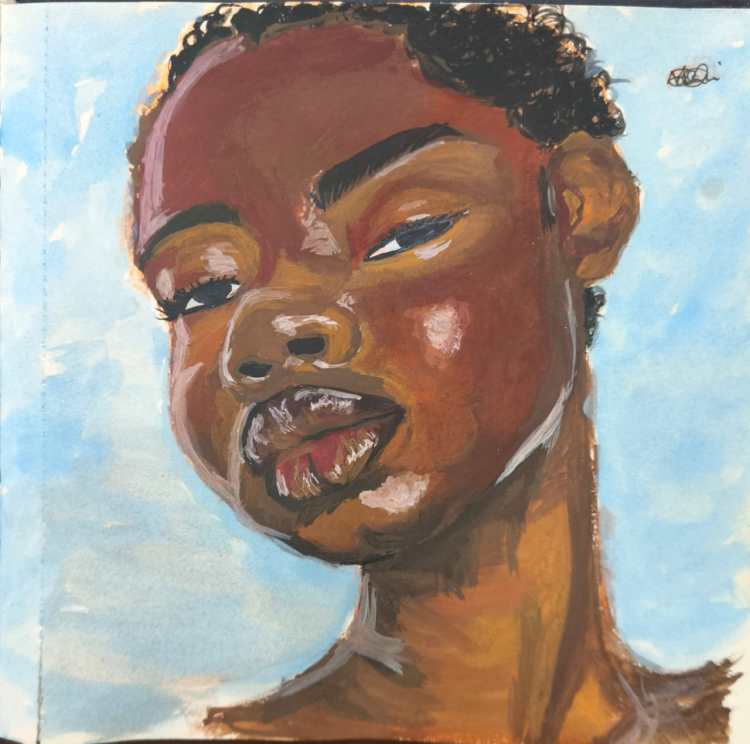
A Black Woman
Gouache on Paper
2026

Red Flowers
Acrylic on Paper
2026
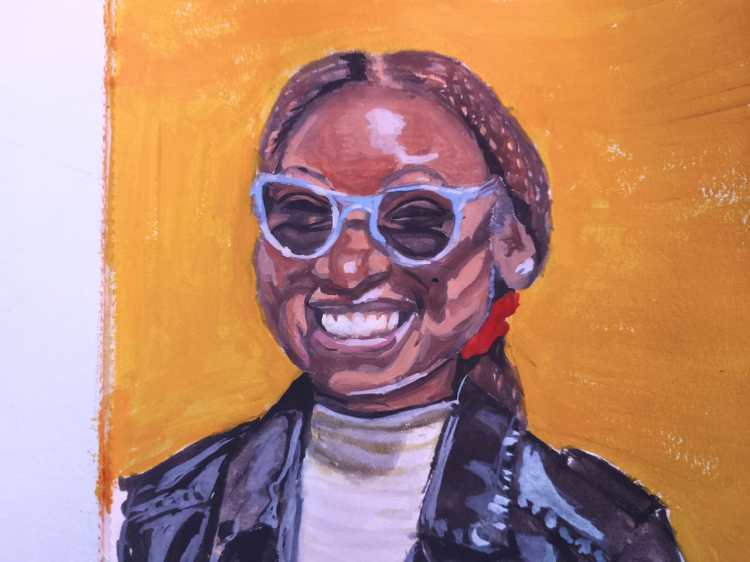
“Untitled”
Acrylic on Paper
2025